
8 years ago, I promised myself I’d never go that long without a real break. I broke that promise.
I’m on my second longer sabbatical of my career. I’ve had my first one in 2018, after an intense 4 years at a startup. Back then, I’ve taken 6 months off, during which I’ve done all of the typical expected things: travel, run, coffee in the middle of the day and reading.
As any young career driven person, I caught myself at crossroads: I wanted to learn, I wanted to grow, but I became disconnected with myself so much that I burnt myself out. Back then, the topic was just beginning to gain traction, but all I could tell myself was: “Is this how the rest of my life is going to be? I just started!”
Little did I know I would go into the depths of Machine Learning, research the Ethics of Machine Learning, get really into the statistics and experiments.
I was quite proud of the sheer baseline curiosity I accumulated then, that I told myself to never let myself without a longer break as I’ve done in those 4 years. While working, I was applying my skills, but in order to stay sane, I need to find time for myself to explore that curiosity and just let it go loose.
8 years passed and I haven’t done it.
I am now taking my second sabbatical, but also lifting my own freelancing practice off the ground.
But is it a sabbatical if you’re building a business?
Yes and no. Research actually has a better answer.
A sabbatical implies 3 stages: Recover, Explore, Practice.
Judged purely as ‘recover,’ building a business doesn’t qualify. Judged as ‘practice,’ it’s a yes.
Currently, I am actively declining clients, although arguably not the smartest decision as a new freelancing business. It feels clear to me that forcing consulting on top of “recovering” wouldn’t be beneficial for any of the parties involved. However, the recovery window tends to stick around for 6-8 weeks, and I’m juuuuuust getting close to it. Right in time for the Q3-Q4 push.
As for the “explore” phase, I’ve done it quite intensely before leaving the cushion of a full time job.
The stages don’t have to happen in order. There are no rules for how to do it.
What if it fails?
This might be the single most common lived experience across many self employed people when taking on such risks. It is such a common question that I personally wake up with every morning. The reality is: it could.
LinkedIn is my main source of inspiration that hopefully it wouldn’t. But it is also filled of survivor bias: the people whom I find inspiring, made it. Whatever version of “made it” means to them. The energy is clear from their posts, and that sort of confidence only comes when the effort and luck coincided in time and market needs.
For the case of data/product analytics, a Salesforce study of ~550 business leaders says that up to 50% of leaders are not fully confident in their data. Personally, I would say that my experience over a decade puts this too kindly.
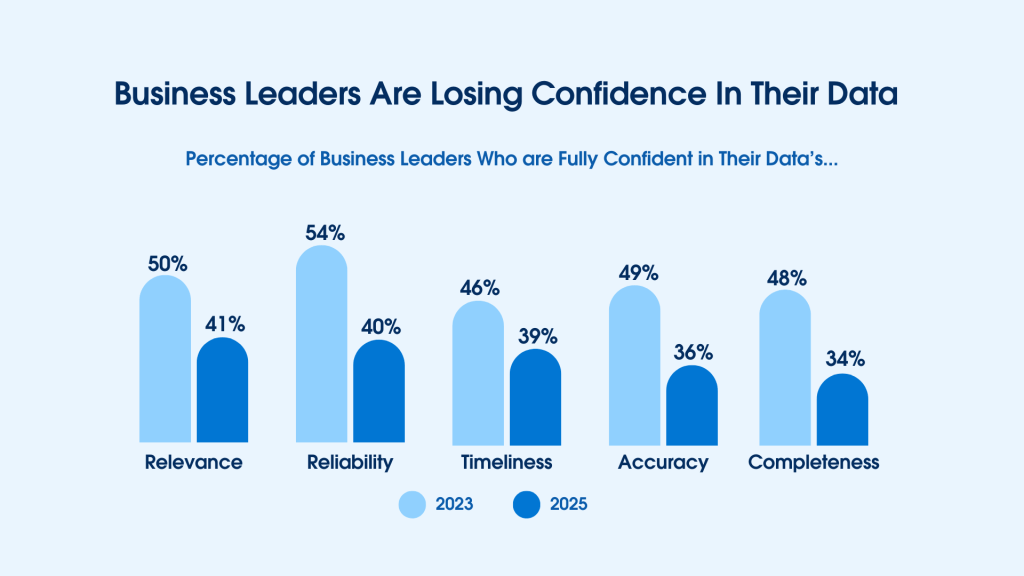
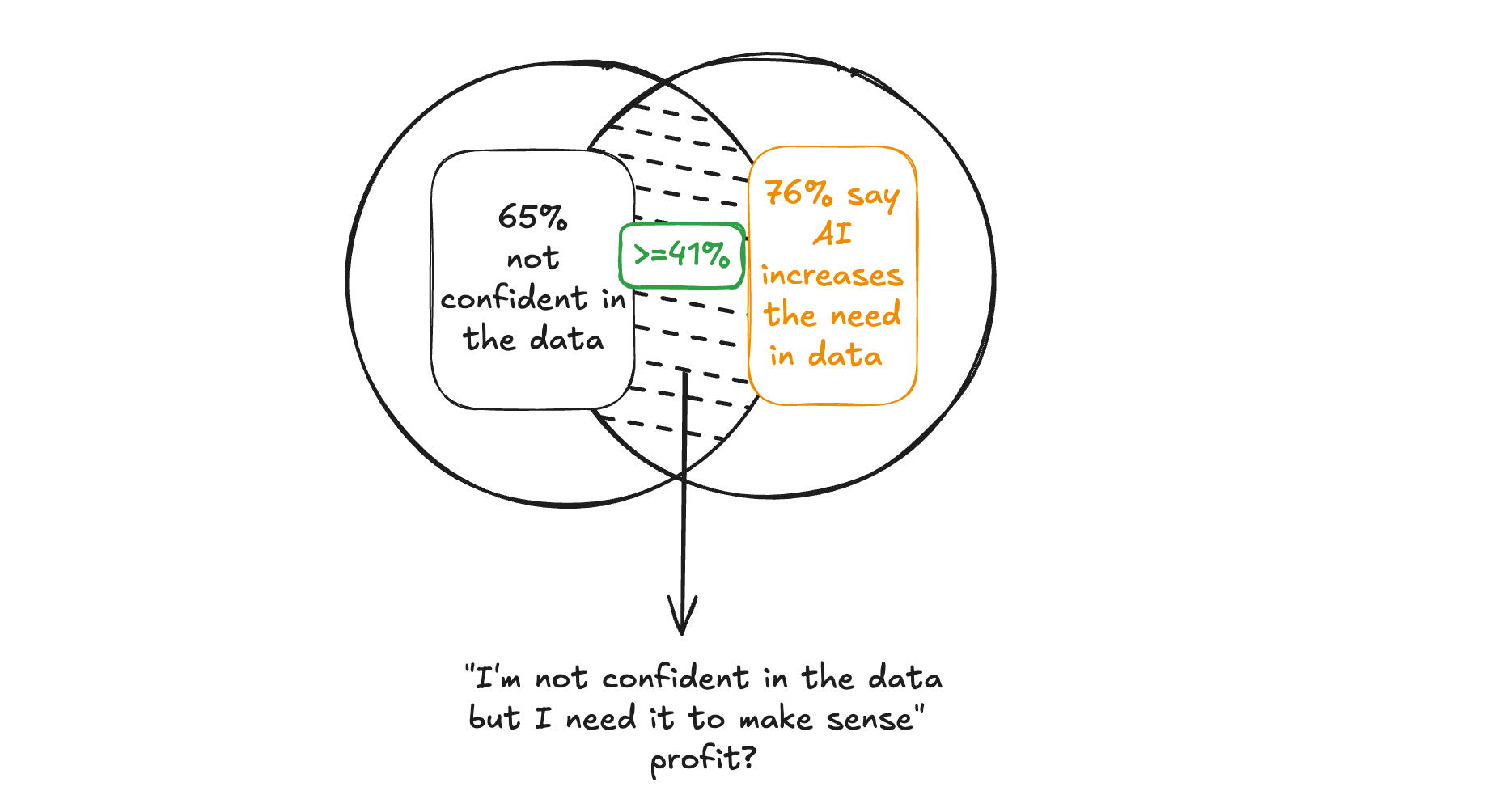
With the rise of AI, and the common agreement globally that the answers AI gives “are almost there”, this trust erodes further to up to 65%. While it could give direction, the lack of accuracy or completeness behind it just increases the mistrust. Every direction becomes shaky.
At the same time, 76% say “the rise of AI increases their need to be data-driven”. Back of the napkin calculations tell me we have at least 41% who are even more convinced than before that data strategy for growth is simply a non negotiable.
In Germany alone as of May 2026 there are 12.8K SaaS businesses of which 1.5K have reached Series A and beyond. Rough back of the napkin (or AI of your choice) calculations assume that there are at any point 60-90 businesses in need of such skills.
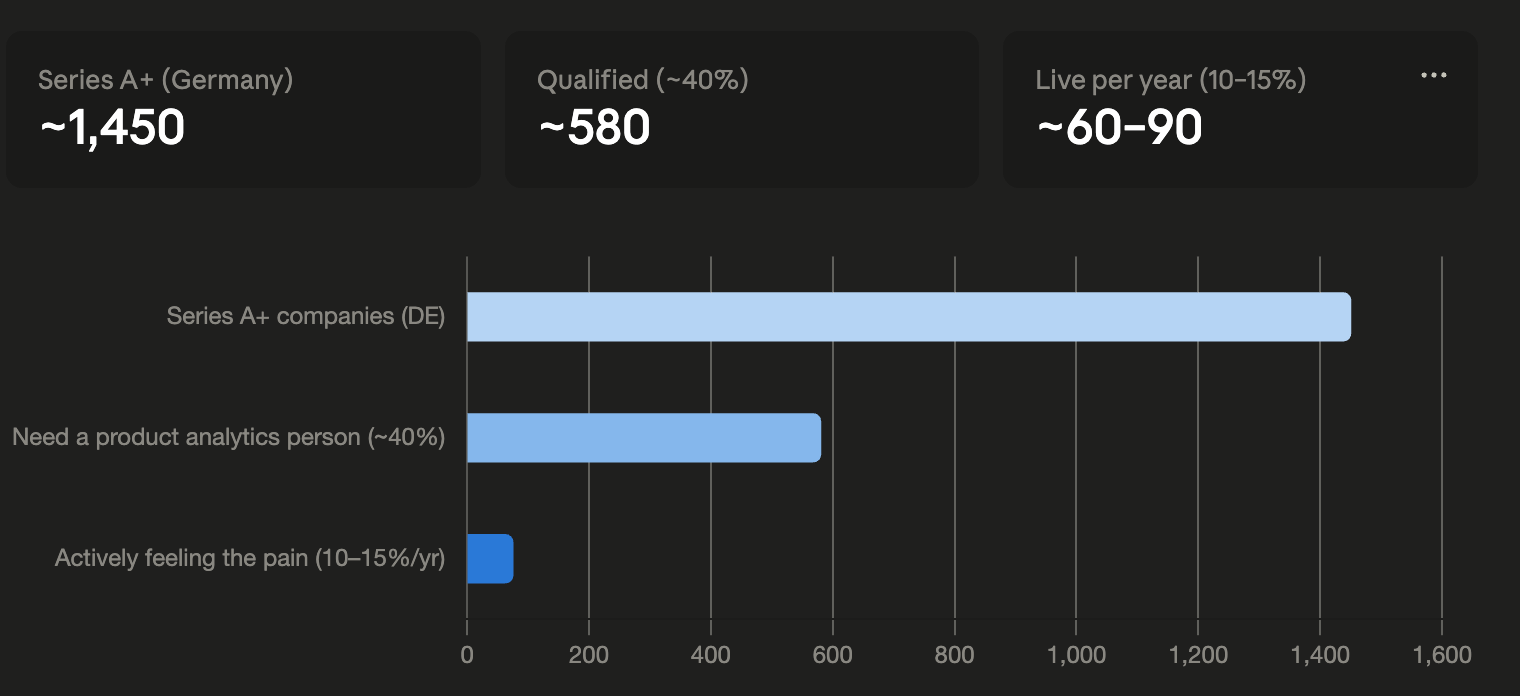
Realistically, anyone in my position needs one-two in a year. So now the work stands simply in positioning and visibility.
I’ve shifted my strategy to aim for a more advisory role, mostly because this is what I’ve aimed for my entire career. When I found my peers who allowed me to do such a role, the creativity was high, results were coming through and generally, the partnership I felt was something that execution alone can’t achieve.
So if “it” fails, it’s a pretty damn cool goal to have it fail. The amount of lessons I’ve learnt in a few months alone are:
shifting my mindset towards abundance
learning about positioning
learning what it means to create a contract
vocabulary around the financial aspect of an offer
reordering the knowledge that I have into offers with concrete boundaries
Six months ago, I didn’t know what a positioning statement was. Now I’ve built one.
That’s the ROI of a sabbatical no paycheck can match.